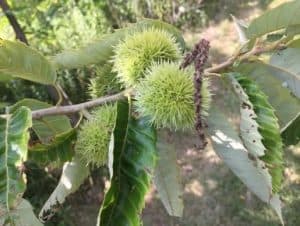
 In yet another tree experiment from this persistent, if not always successful gardener:
About fifteen years, one of our dinner guests brought us chestnuts he had harvested from his own trees. I roasted them the next day. They were absolute delicious. It turns out that they were Chinese chestnuts, immune to the blight that had killed off their American cousins over 100 years ago.
I immediately ordered a tree. It came, I planted it. Then I learned that it takes two to tango, so I ordered a second one. I measured out the forty feet between the two, as instructed.
The instructions also said that it could take three to four years to see results, but although the two trees grew, they did not produce a single chestnut. Year after year, I checked the branches but found nothing.
Until this year. One tree has a bunch of those spiky pods that signal a chestnut crop is on the way.
The second tree, however, had odd looking things growing on its branches. They were much smaller and not at all spiky. What was going on? I opened up my Picture This app and got a very big surprise.
The tree with the odd things wasn’t a chestnut at all. It was a saw tooth oak!
Huh? All these years later, I’m just now finding out that the nursery sent me the wrong tree?
So, my question: Without a second tree to pollinate the first, how did the chestnuts begin to grow? A couple of friends have suggested that there must be a chestnut tree somewhere close by. But there are none. We live far from our closest neighbors.
Will those spiky pods actually have nuts in them? We should know in about a month.
Stay tuned!
 Late spring brings an enormous crop of rhubarb into my backyard. So much so that I end up giving a lot away and freezing the rest. After all, how much strawberry rhubarb pie or blueberry rhubarb crisp can one eat? (Actually, don’t answer that. My scale has told me exactly how much dessert I can eat.)
 I’m currently in the midst of cleaning for Passover and, while dusting off my cookbook shelves, I found a gift from my mother-in-law, a Julia Child cookbook inscribed to me. That started me thinking of the movie Julie and Julia, which then got me thinking that it’s time to start a new project. Because I’m often asked to review cookbooks, I have a LOT of them, but so many others that go untouched from year to year. So, I’m going to try to make one recipe picked at random from each book over the next several months. Let’s see how that goes. There’s quite a selection: Chinese, Spanish,Italian, Asian, African, Israeli, Persian, Lebanese, Syrian …
 h roots onto our front porch. We used one of them on the seder plate.
 I love Indian food, and when given the choice as to what kind of restaurant I’d like to visit, it is more often than not an Indian one — except with certain friends who shall remain nameless. They won’t go near the stuff.