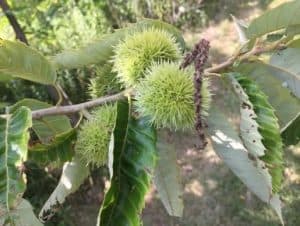
 In yet another tree experiment from this persistent, if not always successful gardener:
About fifteen years, one of our dinner guests brought us chestnuts he had harvested from his own trees. I roasted them the next day. They were absolute delicious. It turns out that they were Chinese chestnuts, immune to the blight that had killed off their American cousins over 100 years ago.
I immediately ordered a tree. It came, I planted it. Then I learned that it takes two to tango, so I ordered a second one. I measured out the forty feet between the two, as instructed.
The instructions also said that it could take three to four years to see results, but although the two trees grew, they did not produce a single chestnut. Year after year, I checked the branches but found nothing.
Until this year. One tree has a bunch of those spiky pods that signal a chestnut crop is on the way.
The second tree, however, had odd looking things growing on its branches. They were much smaller and not at all spiky. What was going on? I opened up my Picture This app and got a very big surprise.
The tree with the odd things wasn’t a chestnut at all. It was a saw tooth oak!
Huh? All these years later, I’m just now finding out that the nursery sent me the wrong tree?
So, my question: Without a second tree to pollinate the first, how did the chestnuts begin to grow? A couple of friends have suggested that there must be a chestnut tree somewhere close by. But there are none. We live far from our closest neighbors.
Will those spiky pods actually have nuts in them? We should know in about a month.
Stay tuned!
 But! Talk about clouds and silver linings. The bulls, having left their bros during the rut, galloped across the plains with their harems. We didn’t view any fights among bulls vying for the ladies’ affection, but we did view one between two antelope.
 Many years ago I bought a wisteria plant at a local garden center. When I got home and took it out of the package, a stick fell out. Just a stick. No root ball hidden by the cardboard label. No indication that it would survive, much less become a magnificent vine heavy with pale purple blossoms.
 It’s snowing again. Rather, still. Here in Central Mass we will be at, or pretty close to, the seven-foot mark by the time this latest in a series of winter storms ends. And, while trees and shrubs dripping with glistening white frosting are pretty enough to illustrate a book of fairy tales, the glossy, gleaming ice dams building up on my roof are big enough to sink an ocean liner.