• Skip to primary navigation
  • Skip to main content
  • Skip to primary sidebar
  • Skip to footer

Carol Goodman Kaufman

a.k.a. Carolinda Goodman

  • Home
  • About
    • Carol Goodman Kaufman
    • Carolinda Goodman
  • Events
  • Articles
    • Art & Culture
    • Travel Writing
    • Food Writing
  • Books
    • Mystery Writing
    • Children’s Writing
    • Non-fiction
  • Podcasts
  • Newsletters
  • TV & Radio
  • Press
  • Blog
  • Contact
  •  

Food

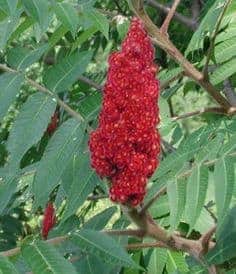
Foraging Sumac

July 22, 2017 by Carol Leave a Comment

Last year, I made the mistake of not reading the small print. The small print in this case wasn’t on a contract; it was on a website. As anyone who reads my stuff knows, I love wild food foraging, and one of the things I have on my to-do list is sumac, its tangy flavor crucial to so many dishes, especially to Mediterranean and Middle Eastern cuisine. Since learning that sumac grows wild all over the Berkshires, I was psyched, and immediately went online to learn how to harvest it in New England. To make a long story short, my enthusiasm overwhelmed my common sense. The website’s author instructed readers to harvest in August, so I enlisted husband, daughter, and son-in-law to join me in the hunt. After all, the latter two are wonderful, adventurous cooks. Armed with plastic bags, we plucked dozens of the ruby red blossoms and brought them home to process on the dining room table. But, UGH. The blossoms were infested with lots and lots of tiny, wriggly worms. I had to throw out the whole lot — as fast as I could hustle myself out the door.

The website was indeed very instructive, but I had failed to notice that it was written in northern Maine, whose season has to be a good month later than ours in southern New England. Lesson: pay attention to the small print.

Tomorrow we go out to try again, the blossoms having just turned red in the past week.

Stay tuned. I have a craving for shwarma.
Filed Under: Food, Wild foods Tagged With: foraging, Sumac, sumac spice, wild food, wild food foraging, wild sumac

Remembrance of Things Spice

June 7, 2017 by Carol Leave a Comment

IMG_3961Proust had his madeleines. For me, opening a container of za’atar releases an aroma that sparks memories of strolling through the shuk, the golden light caresssing ancient stone walls. The scent also stimulates my appetite for fresh-from-the-oven pita, warm, soft and chewy, with a salty and piquant tang.

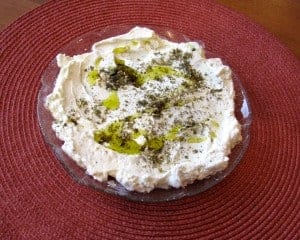
The za’atar that we know from its association with labneh and hummus on mezze plates is a condiment made from a mix of spices, herbs, and seeds, and the recipe varies from place to place.

But in fact, the name za’atar also applies to a family of related herbs that grow in the Middle East: oregano, savory, marjoram, thyme. I think it most closely resembles oregano, at least the bush that grows in my garden.

It’s really easy to mix your own za’atar if you can’t get it locally, or if you simply love the idea of making something from scratch. Just mix the following ingredients together:

  • 1/4 cup sumac
  • 2 tablespoons thyme
  • 1 tablespoon roasted sesame seeds
  • 2 tablespoons marjoram
  • 2 tablespoons oregano
  • 1 teaspoon coarse salt

Filed Under: Food, Gardening, Uncategorized Tagged With: hummus, labneh, marjoram, oregano, pita, Proust, savory, thyme, za'atar

A 24 Carat Dessert

January 4, 2017 by Carol 1 Comment

While doing research on the carob, I learned a lot about its history and culture. This legume is touted as a healthy alternative to chocolate, as it has lots of nutrients and no stimulants such as caffeine or theobromine to give you the jitters. However, the bean has long been denigrated as an inferior chocolate wanna-be, nothing more than a poseur. I found a recipe that I have adapted to include orange juice and coconut oil. These two ingredients give it an amazing tropical vibe. This delicious cake is so moist it really doesn’t require frosting, but including it doubles the pleasure.  And, it redeems the lowly carob!


Ingredients:
For cake:

2 c. unbleached all-purpose flour
2 c. sugar
2 t. baking soda
2 t. baking powder
½ c. high quality carob powder
½ c. coconut oil
1 c. orange juice
2 extra-large eggs
1 c. hot coffee
For icing:
2 sticks unsalted butter at room temperature
4 cups confectioner’s sugar
2 t. orange emulsion (or extract)
2 T. milk

Directions:
For cake:
Preheat oven to 350°.
Grease and flour two 8-inch round cake pans.
In the bowl of an electric mixer, combine first five ingredients.
In a second bowl, mix the oil, milk, and eggs.
Pour liquids into dry ingredients and beat, starting slowly.
While beating, add the coffee and gradually increase to high speed.
Beat for two minutes.
Pour batter into prepared pans.
Bake for 30 minutes or until toothpick placed in center comes out dry.
Cool for 20 minutes, then tip cakes onto cake racks.
When cakes are completely cooled, ice.
For icing:
In bowl of mixer, beat butter until creamy.
Gradually add confectioners’ sugar with mixer set to slow speed so that it won’t fly all over the kitchen.
Add extract and milk.
Increase speed to whip icing to a nice, fluffy texture.


Filed Under: Dessert, Food Tagged With: carob, carob cake, coconut oil, orange juice, recipe, tropical vibe

Weighing In

December 31, 2016 by Carol 2 Comments

So, I promised to bring muffins to my beloved father-in-law who is currently in a rehab hospital. Pumpkin spice seemed seasonally appropriate and the recipe online got five-star raves, so what could be bad? I donned my apron. When the muffins came out like soup, I was more than a bit annoyed. After all, I had followed the directions carefully.

Or had I? Returning to the website on which I had found the recipe, I realized that the 1 1/4 cups of flour was actually 1 1/4 pounds. Because we know several professional chefs who weigh their ingredients, I was aware of the practice, but had never actually seen a recipe calling for that.

Attempt #2 worked out much better, even with substituting half the butter with applesauce.

Next time I will try them using my very nice digital scale.

Moral of the story: Read carefully.

Filed Under: Dessert, Food Tagged With: baking, muffins, pumpkin spice muffins, weighing ingredients

Fun With Fungi: My Virgin Voyage as a Mushroom Hunter

May 29, 2016 by Carol 2 Comments

Few people, either on foot or in cars, were on the road this morning, but who could blame them? The oppressive heat and humidity hadOyster mushrooms been hanging on for days, with no relief in sight. But the weather didn’t deter us; we were off on our very first mushroom hunting expedition. I had been dreaming about this for months and nothing would stand in my way.

We joined up at Kennedy Park in Lenox with some other folks who had traveled some distance for the hunt and were thrilled when John Wheeler, President of the Berkshire Mycological Society, arrived soon after to teach us some basics about mushrooms and mushrooming. Just as I thought we would embark on our quest, he burst our collective bubble by telling us that commercial pickers had wiped the park clean. But, like a novelist who knows how to devise a good plot, he then redeemed himself by bringing us to another place further down the road.

Birdsong and the babble of running water, along with the occasional snapping twig, filled the woods with cheerful music. The forest floor was damp and fragrant with the aroma of decaying leaves. And slippery. I found long branch to use as a walking stick that turned out to be a wise decision.

We hiked down a hill, over felled trees, under branches, and through said babbling brook. I have to admit I  expended more energy attempting to remain upright than I did actually seeking out fungi. Perhaps with practice this will get easier, I thought.

It turned out that John had to leave early to attend a wedding, so we were left to fend for ourselves. Afraid that we would get lost in the woods, we tried to follow him as he ascended the steep embankment with the agility of a gazelle. We realized quickly that we were not going to make it. Remember “slippery?” Well, my feet lost their grip on the muddy slope and as I slid downward, one leg wrapped around a tree while the rest of me continued down the slope. Trust me when I say this was not the most attractive pose I have ever been in, and I pray that nobody had a camera at that precise moment.

Although only one member of our party found a single oyster mushroom, we did succeed in netting some wild ramps and wild ginger, so the hike wasn’t a complete bust.

The beauty of exploring nature with the possibility of finding treasure is enchanting, and I think probably addictive, but next time I’ll stick to flat terrain. And I’ve already ordered a couple of field guides to ensure that I don’t ingest the wrong type of fungus.

As the Croatians like to say, “Every mushroom is edible, but some only once.”

Filed Under: Wild foods Tagged With: mushroom hunting, mushroom scavenging, wild mushrooms

Too Much Pepper in My Paprikash

January 29, 2016 by Carol 2 Comments

9f07b458fee72cec2641a72e8f9aaa68A long time ago I attended a Billy Joel concert with hubby and friends. Seated across the aisle from us was the artist’s then-wife, Christie Brinkley, and their toddler child. (I did say this was a long time ago). Both mother and child were wearing the type of ear protectors that one sees worn by airport workers out on the tarmac. They needed them because the music was almost-literally ear-splitting. I had to cover my ears the entire evening.

What does this have to do with my usual gig, writing about food? Hot pepper.

Hot peppers have become all the rage. The higher the Scoville rating a pepper has, the greater the bragging rights among its fans who eat them. With names like Carolina Reaper and Bhut Jolokia Ghost Pepper, I can practically see the smoke coming out of their ears.

While the high concentration of capsaicin found in hot peppers, when incorporated into an ointment or cream, can help people deal with pain, certain varieties of hot peppers can be dangerous when consumed. Capsaicin is actually a neurotoxin and in large enough doses can cause seizures, heart attacks, and even death.

Historically, the hot pepper had a purpose. In fact, anthropologists believe that it may have helped to ensure the survival of some cultures. Before refrigeration was common, people living in tropical and subtropical climates needed a way to preserve their food. Hot peppers can help protect against the growth of bacteria and fungi. In fact, researchers at Cornell University have found that capsaicin kill or inhibit up to 75% of bacteria in food.

But aside from those reasons, what is their purpose on our dinner plates? With apologies to Harry Burns of When Harry Met Sally fame, when there’s too much pepper in your paprikash, you can’t taste the food.

It’s like going to a concert and not being able to hear the music for all the noise.

Filed Under: Food, Music, Vegetables Tagged With: capsaicin, hot pepper, loud music, Scoville units

  • « Go to Previous Page
  • Page 1
  • Page 2
  • Page 3
  • Page 4
  • Page 5
  • Interim pages omitted …
  • Page 7
  • Go to Next Page »

Primary Sidebar

Recent Posts

  • An New Old Chestnut
  • How to Prepare and Present Your Homegrown Foods, Whether for Gifting or Selling: Guest Post by Clara Beaufort
  • A Proustian Memory and a New Project
  • Good things come to those who wait. And wait.
  • Guest post from Clara Beaufort

Categories

  • Bread
  • Dessert
  • Family history
  • Food
  • Gardening
  • Hanukkah
  • Music
  • Musings
  • Nature
  • Once in a Full Moon
  • Passover
  • Pirate Ships and Shooting Stars
  • Thanksgiving
  • Travel
  • Uncategorized
  • Vegetables
  • Wild foods

Footer

Events & Categories

  • Books
  • Travel Writing
  • Food Writing
  • Art & Culture
  • Podcasts
  • Events

Recent Blog Posts

  • An New Old Chestnut
  • How to Prepare and Present Your Homegrown Foods, Whether for Gifting or Selling: Guest Post by Clara Beaufort
  • A Proustian Memory and a New Project
  • Good things come to those who wait. And wait.
  • Guest post from Clara Beaufort
Follow Carolinda Goodman Follow Mystery and Mayhem Follow Food and Travel With Carol

Copyright © 2026 · CAROL GOODMAN KAUFMAN